Contact Improvisation in Amsterdam & Netherlands
| Home | CALENDAR ( Events and Workshops ) |
Weekly Jam Info | About Contact Improvisation | Contact Us | Images | Other Links |
About Contact Improvisation
-
A Short Introduction to Contact Improvisation
Intorductory Ideas:
Just about anything can happen in a contact improvisation dance. However there are some common techniques that allow the dancers to expand the possibilities, and be safe. Most of these involve understanding simple principles of movement, body awareness, and communication. To name a few, rolling, use of center of mass, understanding positions of strong support, responding sensitively to points of contact, using momentum, and working together. The dancers follow their own inspirations while simultaneously supporting and offering possibilities to each other. Often the impulses of both dancers work together such that the resulting movement is surprising to both .
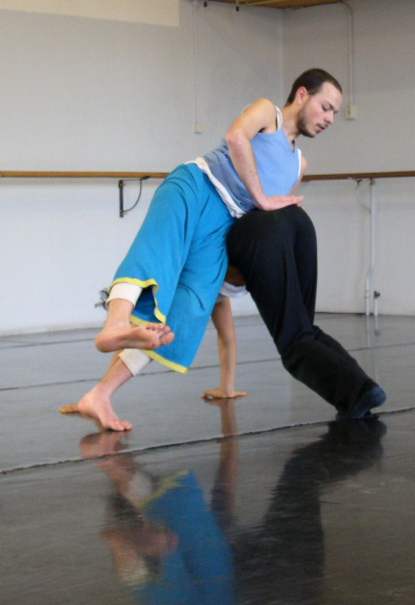
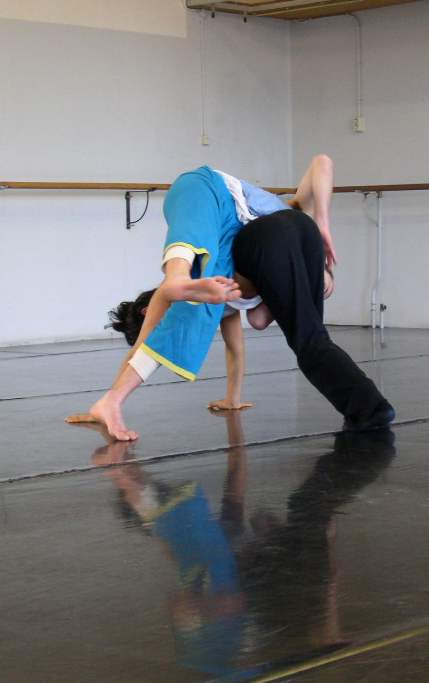
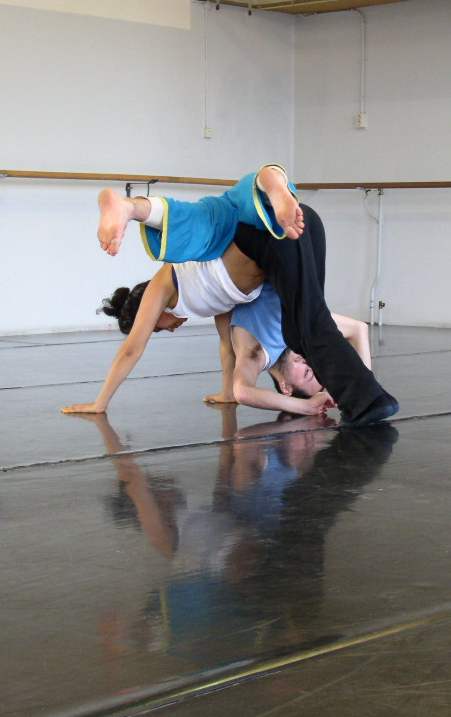
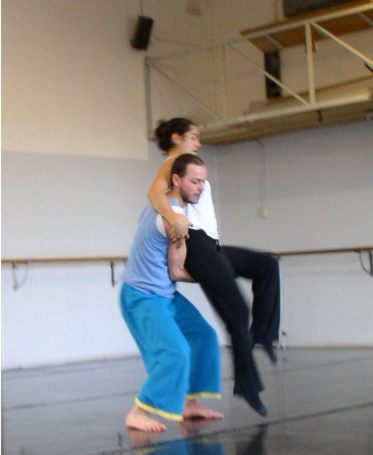
Here are some images and descriptions of two dancers, Pablo and Angela, that may help you to get a picture of what contact improvisation is like. These photos were taken during a jam. So of course none of the moves are "set" as one might see in other dance forms. Rather they occur spontaneously.
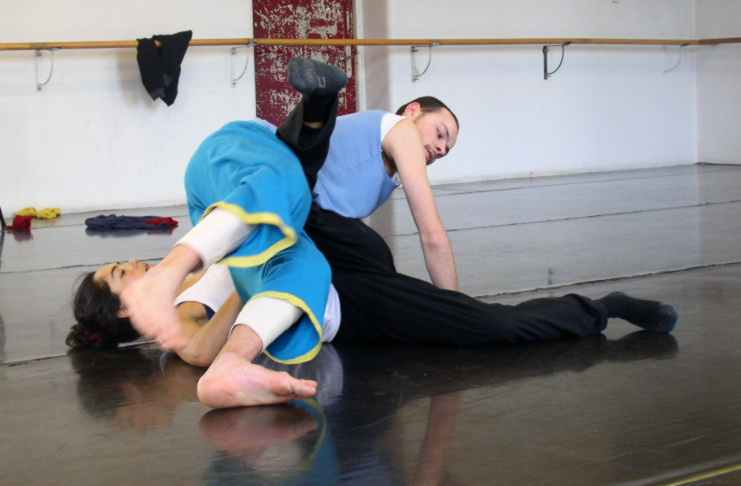
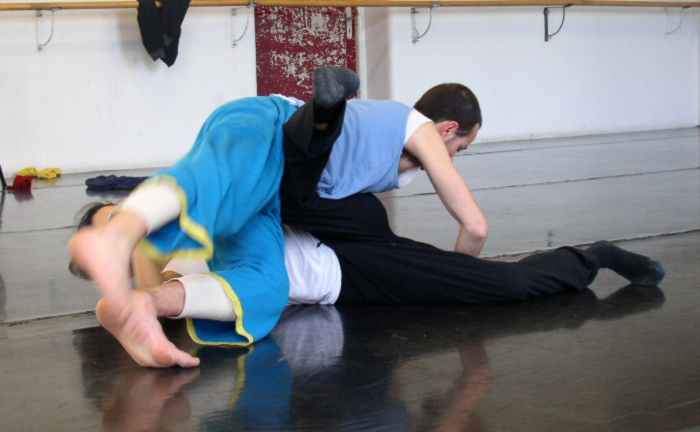
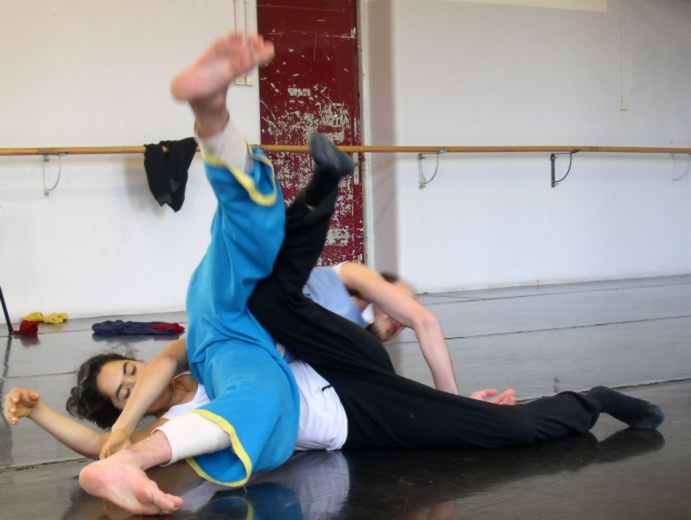
In the first series, the two move low to the ground. This can be the safest level at which to exchange weight. Both Pablo (on top) and Angela are rolling, creating an unpredictable and dynamic dance. Pablo uses all points of contact at his disposal: his hands to guide and support his torso, Angela's stomach and thigh to support and move his hips, and his legs to push off and counter balance. The ability to role comfortably across the floor, with and without a partner is fundamental to contact improvisation.
 |
 |
 |
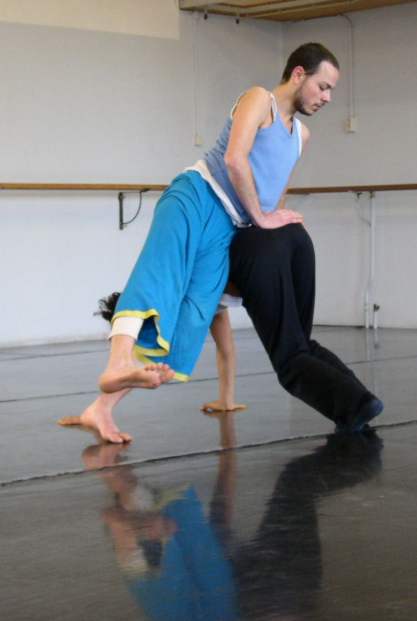
The same kind of dynamic can also occur at a mid-level interaction. Angela has offered Pablo a strong support, which he accepts to go for a little ride. He also takes advantage of the moment to rotate around his own center of gravity, leading into a roll onto the ground. Perhaps Angela will follow him to the ground, maintaining the momentum of the moment. Note that Angela's position is such that there is little strain on her back. Her body position functions as a support by virtue of its architectural stability, rather than her muscular strength.
 |
 |
 |
 |
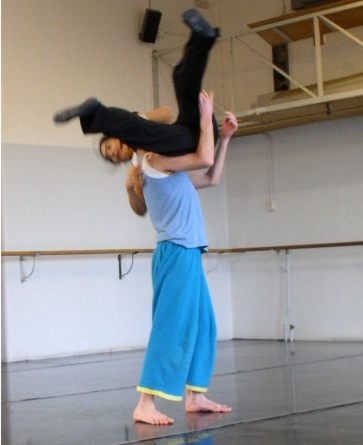
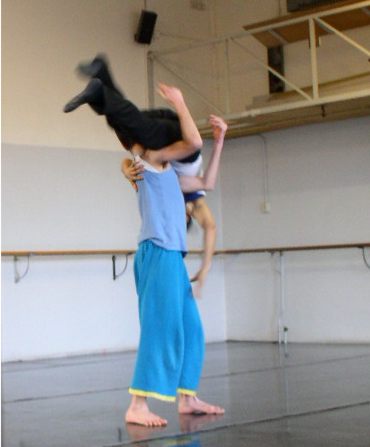
Here is a lift at the standing level. Pablo has offers the opportunity for Angela to go up to his shoulder. Angela reacts with small leap. She again uses a rolling motion to rise further up. She flips up backwards, rolls up Pablo, and spins vertically around her center. The entire motion is made easy and graceful by the fact that Angela keeps here center close to Pablo's strongest point of support, his shoulders. Note that Pablo avoids holding her in place with his hands once she is at his shoulder level. Instead he simply forms a kind of elevated platform with his upper arms. This allows Angela to more clearly sense how her balance and momentum are changing. She can use Pablo's support as she pleases. This adds both safety and freedom to the dance.
 |
 |
 |
In fact, in all of these examples both dancers use their hands very sparingly. This gives freedom to the dance, since neither dancer manipulates the other. Also, it increases the level of safety. The dancers have their hands free to adjust their balance and reach out for support and protection.